
TILT Lab hosted a screening of Valentina Ganeva’s Schindler Space Architect in conjunction with the 2026 Tilt-Up Convention and Expo. Following the screening, Jeffrey Brown, past president of the Tilt-Up Concrete Association and chair of TILT Lab, offered the following review and reflection on the film, Rudolph Schindler and the architect’s enduring relevance to the profession.
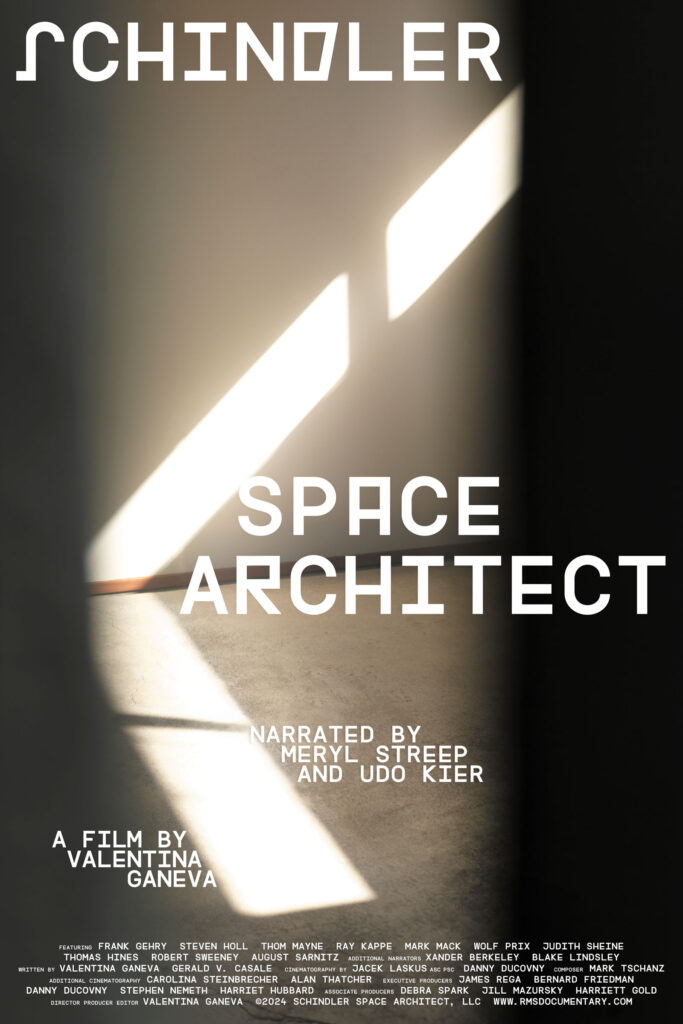
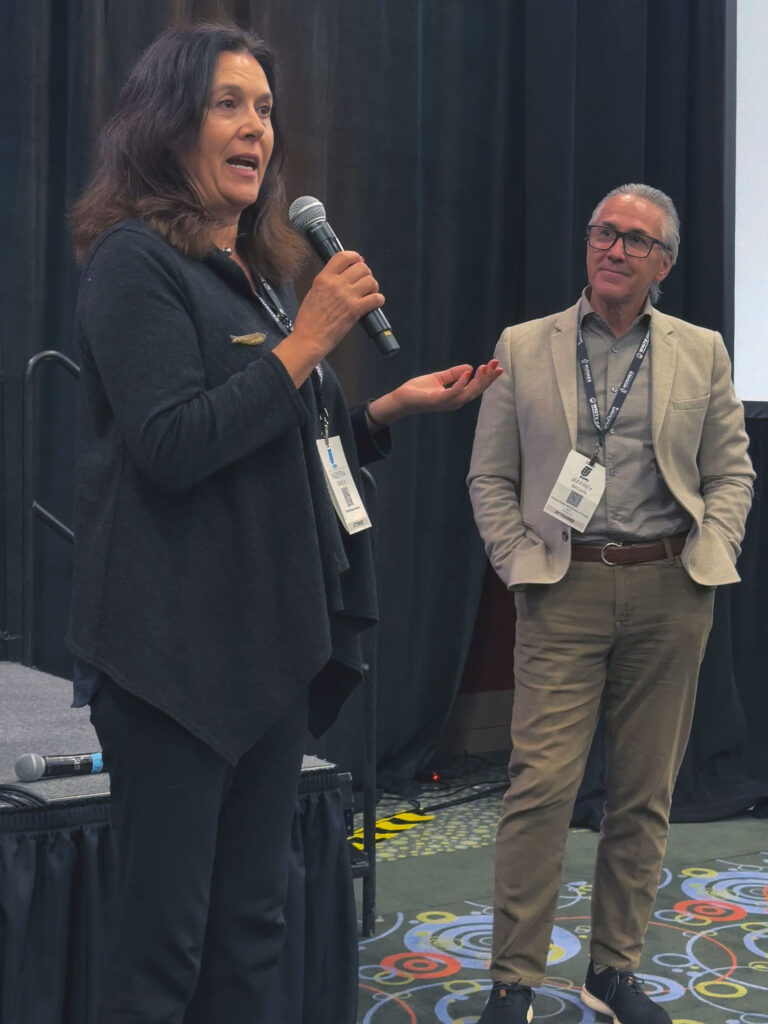
Left: Official poster for Schindler Space Architect (2024), directed by Valentina Ganeva. The documentary explores the life, work and architectural legacy of Rudolph Schindler. Right: Jeffrey Brown, FAIA, FTCA, and filmmaker Valentina Ganeva engage with the audience during a director’s talk following a screening of Schindler Space Architect, hosted by TILT Lab at the 2026 Tilt-Up Convention and Expo.
The TCA is a largely industry-oriented organization of contractors and concrete subcontractors, particularly tilt wall users and the industry supporting the technology. Why are we reviewing a movie about an architect in the magazine? There has been a long-term effort to attract architects to tilt wall and thus this conference. Given the success in Salt Lake City at over one thousand attendees, architects may be the last frontier of big growth, as it seems everyone else is inside the tent. In the vein of appealing to architects yet staying on the theme of concrete and construction technology, the programming struck a kind of asymmetrical equilibrium in offerings specifically for architects. The screening of the film Schindler Space Architect is one successful instance.
Why this movie about this architect? Its relevance to this conference? The answer is nothing short of the fact that Schindler—by way of Frank Lloyd Wright (the most famous of all architects ever) to Irving Gill (the most famous architect in tilt wall)—designed and built the Kings Road House (the most famous building in tilt wall). In addition, this was no conceptual architect; he built most of his work himself.
The movie was designed and made by director Valentina Ganeva and first released in 2024.
It took her 12 years to finish making this picture. Her level of research into Schindler’s personal life, the cultural context he came from in Vienna and the one he created in California, the surrounding influences on his perceptions of space and form, and his intimate relationships that served as the creative inspiration in his greatest works is exhaustive. Thus, I doubt much more will ever come out about Schindler in the future. You inhabit his life as you watch the story unfold.
In the manner that Ganeva is not an architect, I’m not a film critic. I do know the difference between the plotless movement of the Rockettes and a plot in a movie or a book as a working theory, however. Most of my writing has been architectural theory/research and architectural criticism in architecture magazines. I don’t have the skill set to properly cover the film “as a film” in the sense of how it was structured, the craft aspects of its storyline, and the technical alignment of the dialogue and the subject, which I may miss (at the time of writing, the great debate is going on in direction, subject and truth, and the category of documentary around the movie “You Can See Everything”—I suspect the territory of film criticism is morphing a bit…). However, I can talk about how stunningly beautiful it was to watch, starting with a first reaction to watching it closely along with some of you.
It is a well-told story about Rudolph Schindler’s (b. 1887–d. 1956) commitment to what a creative life can look like given a total, relentless commitment by the individual to his own talent. Several strands of overlapping aspects like infidelity, betrayal, legitimacy and dogged determination are each developed sequentially, then merged into a singular matrix illustrating a complex, unique human at a pivotal time in history with a particular talent for translating his vision into structures, experiences and manifestations that, to this day, gesture toward fresh, relevant experiences in space. She makes an architect who died in the fifties alive and relevant for our time.
The main working theme is a series of vignettes that generally adhere chronologically, although she jumps time a bit closer to the end of the film as timelines start to run concurrently. Each “episode” acts as a mini-drama, playing out in voice-overs and period imagery as set pieces of his operations in creativity, social engineering, technical researches and his struggles to make a career out of them. She condenses the short set pieces of his relationships and his work together with binding commentary narrated by Meryl Streep and observations by luminary scholars, starchitects like Frank Gehry (who actually knew Schindler), Steven Holl, Wolf Prix and Thom Mayne, as well as actual contemporary owners of Schindler homes. These interviews stitch the vignettes to relevance by positioning Schindler as an extraordinarily adept inventor—we see what he innovates, then get confirmation that, indeed, what seems prescient and unique is even more so when ratified by the contemporary experts.
Most of the vignettes take place in original and restored Schindler homes (he built mostly residential) in the manner of being in the room—conversations between him and his wife, his own descriptions of the intent behind the spatial strategy he designed and that they cohabitated. Written down for reading, it somehow is not as powerful as the film made it—you could practically see him conceiving. Ganeva establishes how and why he stayed true to his vision. We are convinced of his genius as each work innovates and extends the themes and approaches to his methods. This is the real rarity in her renovation of his importance. Without saying it, she communicates what true commitment looks like—stoic and dogged and still breathtaking. She leaves one wondering what we can do in a world where architects are so willing to reduce their ideas to social-media-friendly bytes that leave us mired in an eerie, reduced sameness while thinking we are establishing uniqueness. I was impressed with the intricate level, as a non-architect, of what she got really right. After watching the movie, how could this not be true? For example, on some front she could have left space less particularly elaborated and have met a reasonable standard.
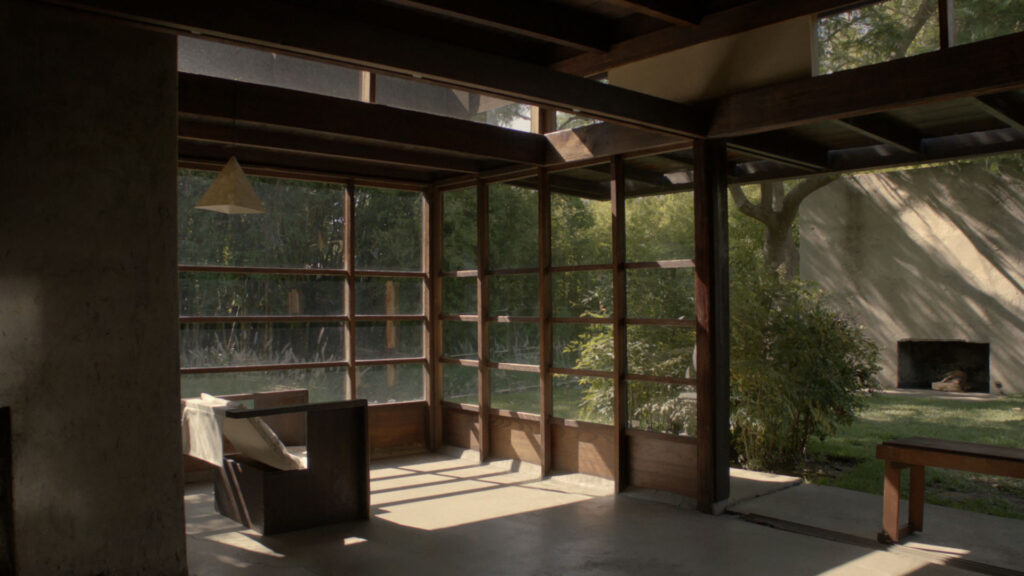
Rudolph Schindler’s studio at the Kings Road House in West Hollywood, California. Completed in 1922, the house exemplifies his pioneering approach to interconnected spaces and the integration of living and working environments.
She called the movie Space Architect because that’s what Schindler called himself. The definition and conceptualization of “space” isn’t even semester-long—it’s lifelong for architects. Yet Ganeva got it right at a very crucial academic difference in typology. The space Schindler understood was in alignment with the roots of true European early modernism. The spatial inventions going on in painting, such as spatial transparency and the depiction of depth without using classical perspective techniques, were new concepts. Particularly, Cubism’s implied depth on the two-dimensional surface of a canvas extended to three-dimensional space and bled over to architecture, and the notion of interlocking or interpenetrating space came with it. This is the medium Schindler exploited in his form-making. Simplified, he deeply believed in an employment of space that was both/and—spaces that were the dining room but also shared a spatial–visual–aligned and abstract relationship with yet another function. This is very different from discrete spaces that define functions—dining room, living room—defined and controlled. For Schindler, space was a matrix that functions were carefully integrated into. For architects, this is a holy grail issue.
Ganeva also covers the numerous fraught relationships Schindler experienced. This turned out to be more important than is obvious. He ran Frank Lloyd Wright’s office for a period of time. He also designed the famed structural system that saved Wright’s Tokyo Hotel from collapsing in an earthquake, making Wright world famous, and was never credited. Wright at various times refused to make connections and/or recommendations for Schindler. His countryman and close friend Richard Neutra followed him to California, and Schindler housed him and his wife and child for a number of years. They worked in the same studio in their individual practices and collaborated. Over time, Neutra variously failed to credit Schindler or even went so far as to steal ideas or claim authorship of projects he did not author. It should be noted that Neutra’s employment of space was the classical discrete-space type, and thus, while he created numerous important buildings, none of them were at the same level of complexity and invention regarding form and materials, to say nothing about spatial beauty.
Yet the true genius of Schindler found ways to overcome these indignities for the most part. Some could not be overcome. Well-known society architect Philip Johnson was co-curating the Modern Architecture: International Exhibition for the Museum of Modern Art and, despite the recommendations from all corners and in wanting to cover the happenings on the West Coast, chose Richard Neutra rather than the better-known but much more bohemian talent of Schindler. Neutra had by then less influential work but complied with what we would now see as a bourgeois corporate class of talent. Ganeva is able, without saying it, to show that this was the boundary horizon for Schindler and was never breached in his lifetime.
Even the short and somewhat shallow analysis above may lead you to believe Schindler would be taught as a core iconic architect to students. The real story is he is, in some ways, an acquired taste, a seasonal, as in every eight to ten years or so he resurfaces as relevant as a foil against trends like big corporate architecture becoming too popular, or starchitects going too far toward the avant-garde’s edge, and Schindler is dusted off for a dose of “what it’s really all about.” He is certainly in the curriculum, but as history most of the time. But he is, by all definitions, a B-lister in the canon.
Ole Bouman, the former director of the architecture program at M.I.T., recently has written about the declining state of architecture and practice and its headwinds in attracting new talent to the profession. He states, “The precarious situation of individual architects is keeping the discipline, and the cultural power of architecture, away from the focus it deserves.” He attributes this to large corporate architecture, AI intrusions in human design-making and, in general, a cultural lack of appreciation for what architecture should be used for, what it can do. He concludes: “There are people who try to stick to the reasons they chose architecture in the first place. I almost never come across an 18-year-old choosing architecture for the life that most architects lead when they are 40. The gap between what you think at 20 and what you do at 40 is huge. There are, however, still many people who are trying to find enough substance in their work to remain faithful to their initial drive.” I hope this movie rejuvenates the importance in deep founding of Schindler’s work in a way that it is the substance architects need now.
Jeffrey Brown, FAIA, FTCA
Creative Director
Powers Brown Architecture

Be the first to comment