
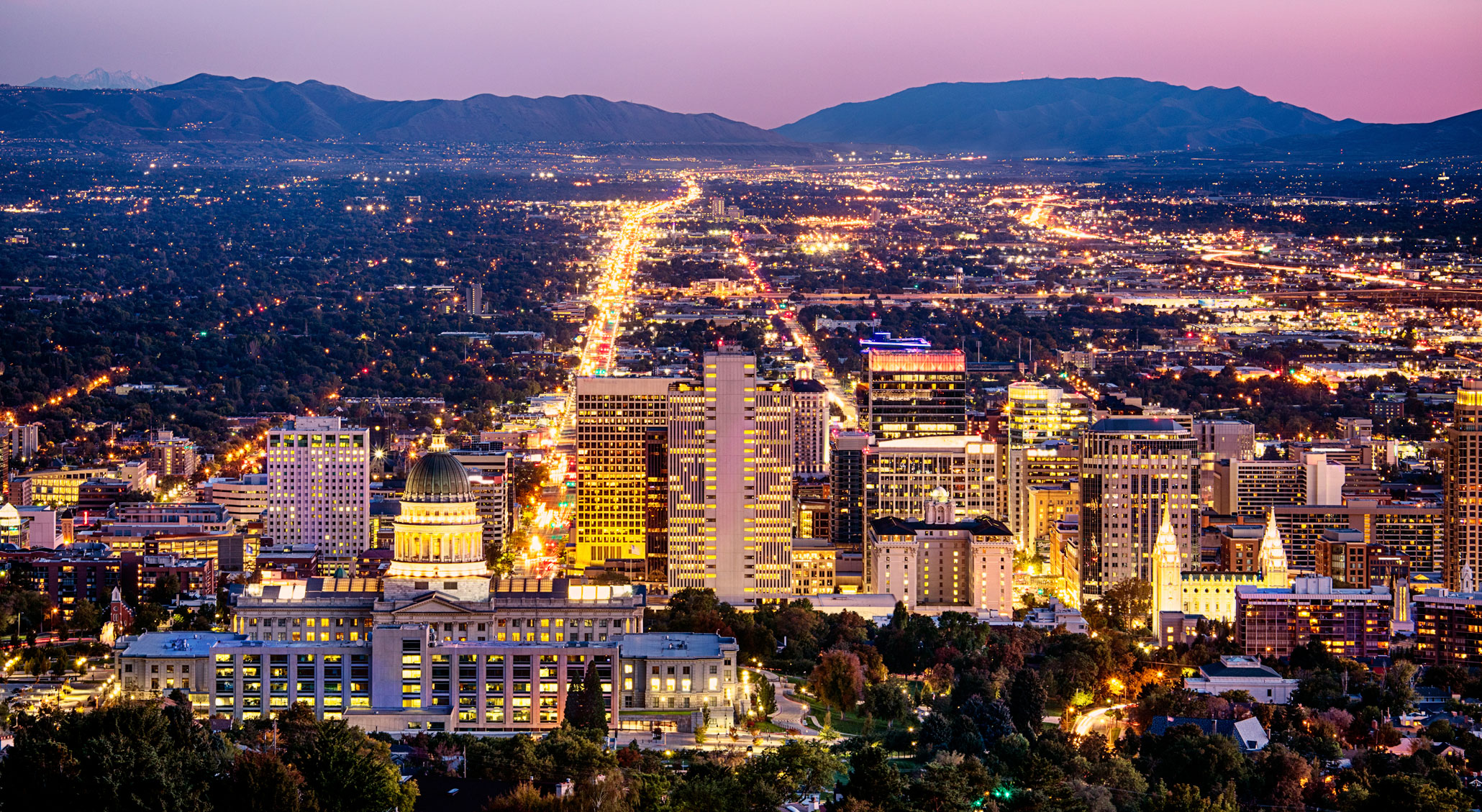
When the tilt-up industry gathers in Salt Lake City this October, it will do so with more Host Sponsors supporting the Tilt-Up Convention & Expo than in any previous Convention city.
That level of local support deserves recognition. It also tells us something about the market the industry is coming to visit.
Utah is unquestionably a strong market for tilt-up. Warehouses and distribution facilities are part of the explanation, but they are hardly the whole of it. Across the state, tilt-up has moved well beyond the familiar industrial building into schools, offices, retail, civic facilities, and increasingly expressive architecture.
The record Host Sponsor response provides a reason to look more closely at how that happened. Behind the projects is a regional construction community that has developed around tilt-up, and over time that community has changed what people in the market believe the system can do.
Darian St. Michael of Hughes General Contractors describes the attitude simply.
“Instead of saying, ‘this is what tilt-up is, and this is what it does,’ Utah seems to say, ‘what if we could do this?’”
A Market That Made Sense
There were practical reasons for tilt-up to establish itself here.
Travis Davis of Hughes General Contractors points first to geography. The Great Salt Lake region has long been known as the “Crossroads of the West,” and the convergence of I-15, I-80, and I-84 continues to support significant warehouse and distribution demand.
Derrick Pack, president of North Utah for CRH Americas Materials and Jack B. Parson Ready Mix Concrete, similarly points to sustained population and economic growth, private investment, and the region’s role as a logistics and distribution hub for the western United States.
Those conditions created demand for exactly the characteristics tilt-up could readily provide: speed, flexibility, durability, and value.
Utah’s environment reinforced the fit. Davis notes the usefulness of a durable, straightforward building envelope in a region that moves between hot desert summers and cold, snowy winters.
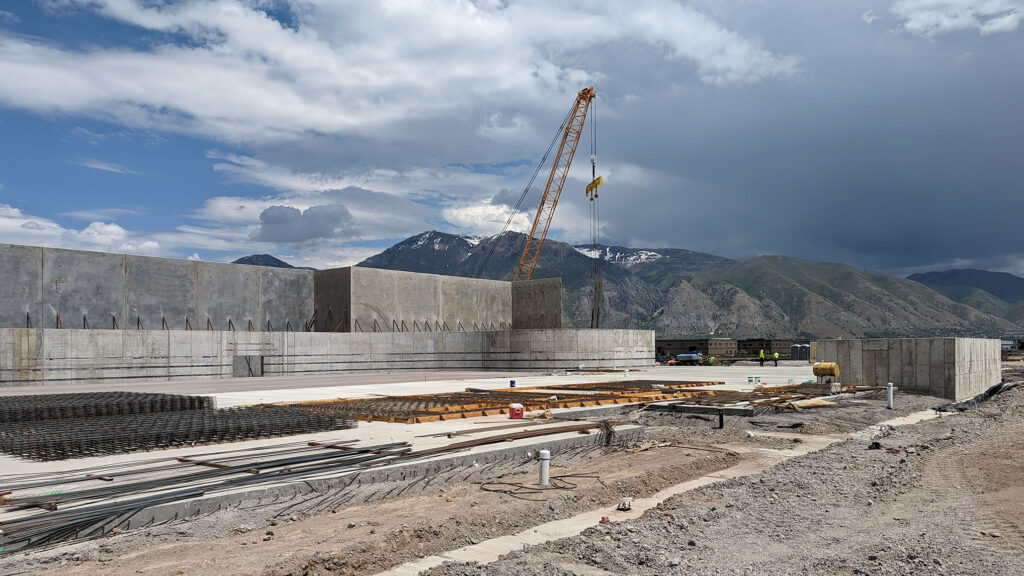
The Dry Creek Transfer Station under construction in Spanish Fork, Utah, with the Wasatch Mountains rising in the distance. The 132,000-square-foot facility uses tilt-up concrete to provide the durability and scale required for its demanding operations.
But practical suitability only explains why tilt-up gained a foothold. It does not fully explain what happened next.
As Davis sees it, the economics that made tilt-up attractive for warehouse construction also encouraged the local industry to adapt the method for other building types. Schools, offices, and retail centers followed.
A construction method that had made sense economically began to present another possibility.
It could become architecture.
Success Begets Success
Dan Pratt, senior vice president of Hughes General Contractors, describes the development of creative tilt-up in Utah through a simple idea: “success begets success.”
His own experience provides a useful illustration.
Early in his career, Pratt was involved in converting the design of a 500,000-square-foot F-16 repair facility from offsite precast to onsite panel casting while maintaining the finish quality expected of plant-cast panels. The experience demonstrated something important: tilt-up concrete did not necessarily need to disappear beneath paint. With the right processes and attention to finish, the concrete itself could become the finished architectural surface.
Later came another question.
Could integrally colored site-cast concrete, already demonstrated on a small office building, work at the scale of a high school?
Working with a designer and a school district facing rapid growth, the team developed that idea for Snow Canyon High School. The resulting red concrete panels responded to the surrounding landscape while giving the district an economical and durable building.
More important than any single technique was what the project demonstrated.
Tilt-up could solve the practical problem and contribute to the architectural idea at the same time.
Other projects followed. Pratt points to public buildings that explored curved panels, unusual panel shapes, etched artwork, integral color, and exposed concrete. Private-sector designers began pushing geometry and relationships between panels further as well.
The result, in Pratt’s description, was a “flywheel effect.”
Each successful project made the next experiment a little less improbable.
Raising the Bar
A flywheel needs more than individual creativity. It needs a community capable of transferring confidence from one project to another.
That is the characteristic that appears repeatedly in descriptions of Utah’s tilt-up market.
Pack describes a construction community in which owners, designers, contractors, and material suppliers work together to solve problems and deliver increasingly complex projects. Rapid growth along the Wasatch Front, he argues, has required the industry not only to scale but to keep raising expectations for safety, quality, schedule, sustainability, and innovation.
Davis likewise sees collaboration among the owner, designer, engineer, and contractor as central to the way tilt-up advances.
St. Michael takes the idea one step further. In a relatively small market, companies do not develop in isolation. They see what others are doing.
“The thing that makes it work is that different companies are watching and pushing each other to do better and the bar keeps being raised.”
That observation gets at something important about how a regional construction culture develops.
Competition does not necessarily prevent shared advancement. In some cases, it accelerates it.
One architect sees what another project accomplished. A contractor encounters a detail that previously seemed impractical. An owner sees concrete used in a way that changes expectations for the next facility. Engineers, suppliers, and craftspeople accumulate the knowledge required to execute increasingly demanding ideas.
No one project creates the market. No one company does either.
The market advances because the next project does not begin where the previous generation began.
It begins where the last successful project left off.
Seen in that context, the breadth of local companies supporting this year’s Convention is significant. The Host Sponsor community spans many of the disciplines and capabilities required to move a tilt-up project from an idea to a finished building. Their participation reflects the same interconnected construction culture that has helped the market advance.
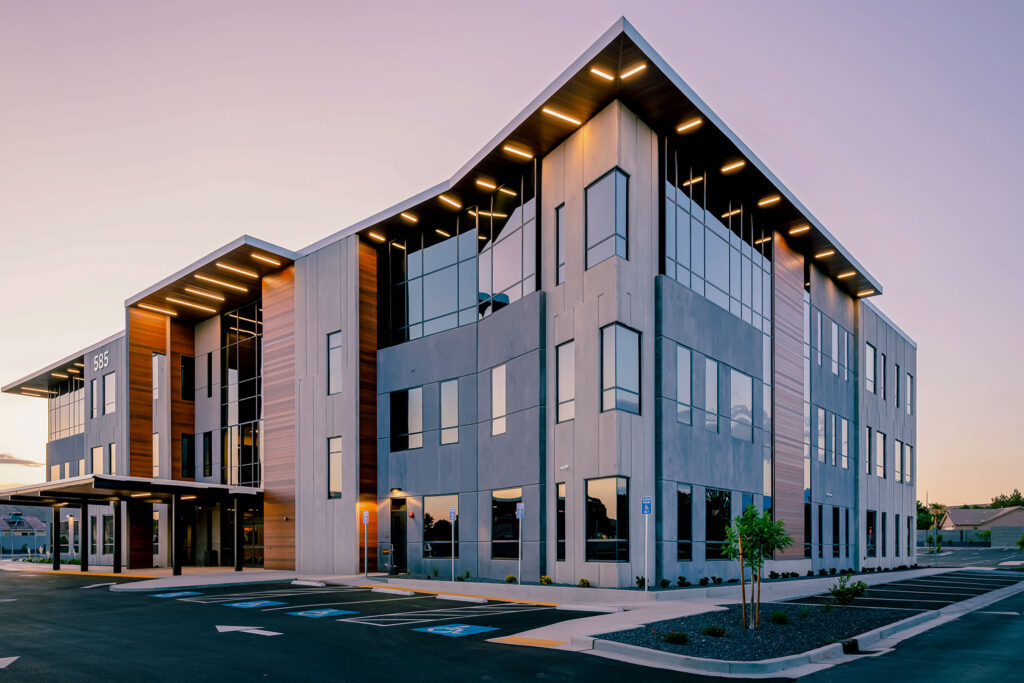
Riverfront Medical Center in St. George, Utah, demonstrates the architectural range of tilt-up through integrally colored exposed concrete, overlapping panels, deep reveals, and contrasting woodgrain aluminum accents.
Let Designers Imagine
Eventually, a market that works this way develops a different relationship with possibility.
The question is no longer simply whether tilt-up is an appropriate construction method. The question becomes what the material and the process might contribute to the architecture.
Pratt argues that tilt-up should increasingly be considered alongside materials selected for architectural expression rather than continually measured only against utilitarian alternatives. His challenge to the industry is straightforward: stop responding to ambitious ideas with “no, that can’t be done with concrete” and instead figure out how it can be done.
St. Michael arrives at nearly the same principle from the contractor’s perspective.
“Let designers imagine, then try to figure out how you can build their vision.”
Neither statement suggests ignoring economics, constructability, engineering, or the realities of concrete. In fact, the opposite is true. Making an ambitious idea buildable requires those disciplines to engage more deeply with one another.
That may be one of the most useful things Convention attendees can take from Utah.
The architectural possibilities visible in the market did not emerge because someone decided tilt-up should become more expressive. They emerged through repeated collaboration: an idea proposed, a problem solved, a project completed, a lesson absorbed, and then another team asking whether the next thing might also be possible.
Shared Ascent
That makes Salt Lake City an appropriate setting for a Convention organized around the idea of Shared Ascent.
The connection is not merely metaphorical.
Utah’s tilt-up market offers a case study in what happens when advancement becomes cumulative. Owners create opportunities. Designers test possibilities. Engineers and contractors make them buildable. Suppliers and craftspeople develop the capabilities required to execute them. Competitors observe the results and establish a new starting point for their own work.
Success begets success.
This October, the companies that make up the largest Host Sponsor community in Convention history will welcome the tilt-up industry to the market they have helped build and continue to advance.
Their support makes the 2026 Tilt-Up Convention & Expo possible. More importantly, taken together, they represent something attendees will encounter throughout their time in Utah: a construction community in which knowledge, competition, collaboration, and ambition have accumulated over decades.
The buildings are the visible result.
The community behind them is the larger story.
2026 Salt Lake City Host Sponsors
The Tilt-Up Concrete Association gratefully recognizes the organizations whose support as Host Sponsors reflects the extraordinary strength of the local community welcoming the industry to Salt Lake City.
Platinum Host
AE URBIA · Big-D Construction · Frontline Concrete Contracting LLC · Geneva Rock Products · Hughes General Contractors · Suntec Concrete · Tom Stuart Construction · Total Integrated Panel Systems · UFP Concrete Forming Solutions · VMG NeXT Construction
Gold Host
Bonneville Builders LC · Staker Parson Companies · Stout Building Contractors
Silver Host
BHB Structural · Convergent · Dunn Associates, Inc. · Graydaze Contracting · Monsen Engineering · Price Real Estate · Utah Ready-Mixed Concrete Association
Additional Local Support
Associated General Contractors, Utah Chapter · ACI Intermountain Chapter

Be the first to comment