
This article is the second installment in Building Sustainability into Tilt-Up, a six-part series from the Tilt-Up Concrete Association Sustainability Committee expanding on the recommendations introduced in Considerations for Sustainability in Tilt-Up Construction. Each article explores one consideration in greater depth, offering practical strategies that project teams can use to reduce environmental impact while improving project performance.
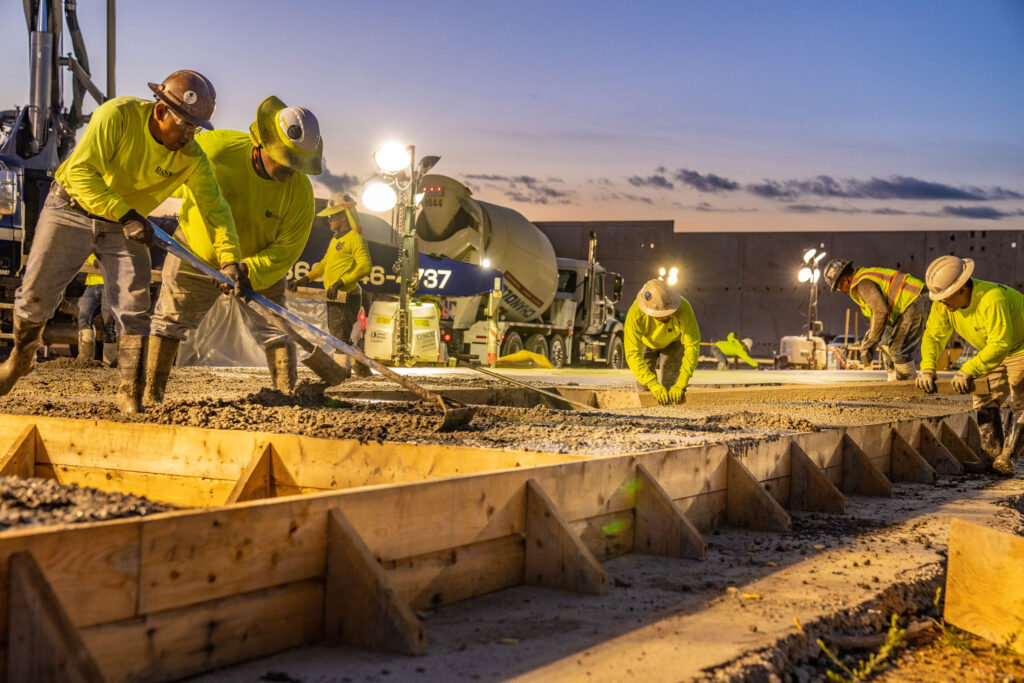
Crews place and finish concrete during an early-morning tilt-up panel pour, illustrating the importance of mixture workability, placement characteristics, and construction performance.
Every concrete mixture represents a series of decisions.
The structural engineer establishes the project’s performance requirements. The contractor develops a construction sequence. The concrete contractor identifies placement and finishing needs. The ready-mix producer develops a mixture using locally available materials capable of meeting all those expectations.
The best concrete mixtures are not created by chance. They are the result of clear communication about what the concrete must accomplish.
This is the principle behind performance-based specifications.
Rather than prescribing exactly how concrete must be proportioned, performance specifications define the results the concrete must achieve. Strength, durability, serviceability, workability, and appearance remain the objectives, while concrete producers gain the flexibility to optimize mix designs using available materials and evolving technologies.
Define the Desired Outcome
Performance specifications begin by understanding how each concrete element will be used.
Tilt-up panels, foundations, floor slabs, and architectural concrete often have different performance expectations. Requirements may include compressive strength, tensile performance where applicable, maximum aggregate size, slump, water-cement ratio, air entrainment, durability, and architectural appearance. Sustainability objectives, including embodied carbon reduction targets, should also be identified whenever they are part of the project requirements.
By defining the required performance instead of prescribing specific ingredients, designers allow concrete producers to develop mixtures that satisfy project needs while making effective use of locally available materials and supplementary cementitious materials (SCMs).
Collaboration Produces Better Mixes
Successful mix designs are rarely developed in isolation.
Structural engineers, general contractors, concrete contractors, ready-mix suppliers, and owners all contribute information that influences the final mixture. Construction schedules, placement methods, finishing techniques, lift schedules, and architectural expectations all affect how concrete should perform.
Concrete suppliers should understand more than the specified design strength. They also benefit from knowing when strengths must be achieved, anticipated placement rates, finishing requirements, and any special construction considerations that influence mixture development. These discussions frequently identify opportunities to improve constructability while supporting project sustainability.
Innovation Requires Verification
Performance specifications create flexibility, but flexibility should always be supported by testing.
Most mix designs submitted for projects are based on historical performance. New cement types, revised SCM contents, or lower-carbon mixtures may require additional evaluation before construction begins.
Trial batches provide an opportunity to verify workability, strength development, finish characteristics, and constructability. Mockups and test slabs allow contractors to understand the plastic properties of unfamiliar mixtures while giving owners and designers confidence that both structural and architectural expectations will be achieved.

Concrete test specimens are prepared in the field, supporting the evaluation of material properties and verification of mixture performance against project requirements.
The industry’s transition from Type I/II cement to Type IL cement illustrates the importance of verification when materials change. In some markets, Type IL was initially presented as a pound-for-pound substitution that did not require new mix design numbers. Contractors and engineers raised concerns with that approach because a change in cement type can affect concrete behavior even when mixture proportions remain otherwise unchanged. Clearly identified mix designs, supported by appropriate testing and mockups, give producers, contractors, and designers an opportunity to understand those differences before they affect an active project.
Sustainability Depends on Flexibility
Many of today’s lower embodied carbon concrete mixtures rely on increased use of supplementary cementitious materials or other mix optimizations.
Rigid prescriptive specifications can unintentionally limit these opportunities by requiring ingredients or proportions that no longer reflect current materials or production methods.

Crews place and finish concrete for tilt-up panel construction, demonstrating how mixture workability, placement methods, and construction sequencing influence performance in the field.
Performance specifications provide producers with the flexibility to recommend lower-carbon alternatives while still satisfying structural, durability, and serviceability requirements. When owners establish embodied carbon goals early in design, project teams can evaluate multiple mix options and identify practical approaches before construction begins.
Communication Is the Real Specification
A successful concrete specification communicates more than strength requirements.
Mix design submittals should clearly identify cement types, current mill certifications for cement and aggregates, unique mix design numbers when multiple cement types are used, and any sustainability objectives established for the project. Equally important is maintaining open communication among designers, contractors, and suppliers throughout the process as project conditions evolve.
Performance-based specifications are ultimately about trust. They establish clear expectations while allowing experienced concrete professionals the flexibility to determine the most effective way to meet them.
That flexibility not only encourages innovation—it also creates opportunities to reduce embodied carbon, improve constructability, and deliver better-performing tilt-up projects.
Looking Ahead
The next article in the Building Sustainability into Tilt-Up series explores When Strength Matters Most, examining how aligning strength requirements with construction sequencing can expand mix design options while supporting both project performance and sustainability.
By the Tilt-Up Concrete Association Sustainability Committee
Photos by Mathew McFraland

Be the first to comment