
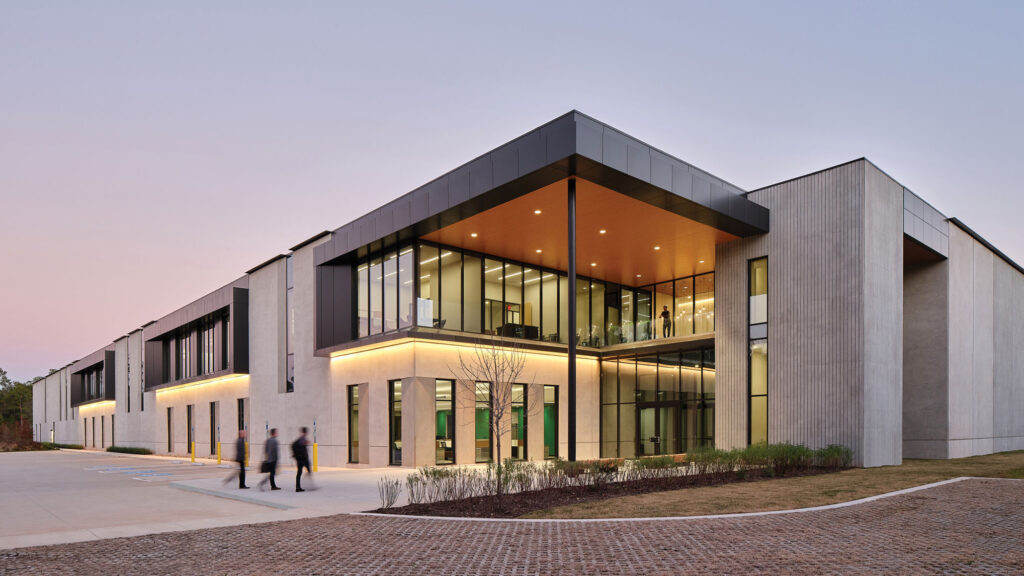
VGXI Headquarters + Biomanufacturing Facility, Conroe, Texas.
Designed around the realities of schedule, cost, and regulatory control, tilt-up panels are used as modular, high-performance enclosure elements—illustrating how delivery-system clarity enables sophisticated architectural outcomes in advanced manufacturing environments. Photo: Keith Isaacs Photography
Tilt-up construction is still too often discussed as though it were a building type—something suited to a narrow set of applications and easily ruled in or out based on appearance alone. Warehouses, distribution centers, and industrial facilities continue to dominate the mental image. That association is understandable. It is also limiting.
In practice, tilt-up is not a typology. It is a delivery system—one with specific strengths, constraints, and proven patterns of success. When evaluated solely through building type, its relevance appears narrow. When evaluated as a system that integrates structure, enclosure, schedule, and cost, its applicability expands significantly.
This distinction matters, because many projects that could benefit from tilt-up are never meaningfully considered for it. The question is not whether tilt-up can do everything. It cannot, and it should not be positioned that way. The more productive question is where tilt-up already performs well—but remains misunderstood or underutilized.
How Misconceptions Take Hold
Most misconceptions around tilt-up are not technical. They are historical and cultural.
Early applications shaped perception. Familiar project types reinforced habits. In many regions, decision-makers have seen tilt-up used in a limited context and assumed that context defined its limits.
Another contributor is the tendency to judge systems by their weakest expressions rather than their best. Every construction method has projects that undersell its potential. When those examples become representative, the system itself is dismissed prematurely.
What follows is not an argument for broader use by default, but a reframing of building categories where tilt-up’s capabilities are already established—and still routinely overlooked.
Office Buildings (Low- to Mid-Rise and Beyond)
Office buildings remain one of the most underestimated candidates for tilt-up construction. Persistent assumptions about façade refinement, proportion, and architectural expression often remove tilt-up from consideration early in design.
In reality, tilt-up panels offer precise control over geometry, surface, and articulation. Long spans align naturally with flexible office planning. Thermal mass and enclosure performance contribute meaningfully to comfort and energy efficiency. For owner-occupied projects, schedule certainty and cost predictability are not secondary benefits—they are central drivers.
Beyond perception, tilt-up has also proven itself structurally in this category. Numerous four-, five-, and six-story office and medical office buildings utilize tall, load-bearing tilt-up panels as primary structural elements. These buildings are not experimental. They are operating precedents that demonstrate how tilt-up can function vertically when the structural role of the panel is clearly defined.
Success here depends on allowing architecture and structure to establish panel logic—not on forcing panels to imitate other enclosure systems.
Education: K–12 and Higher Education
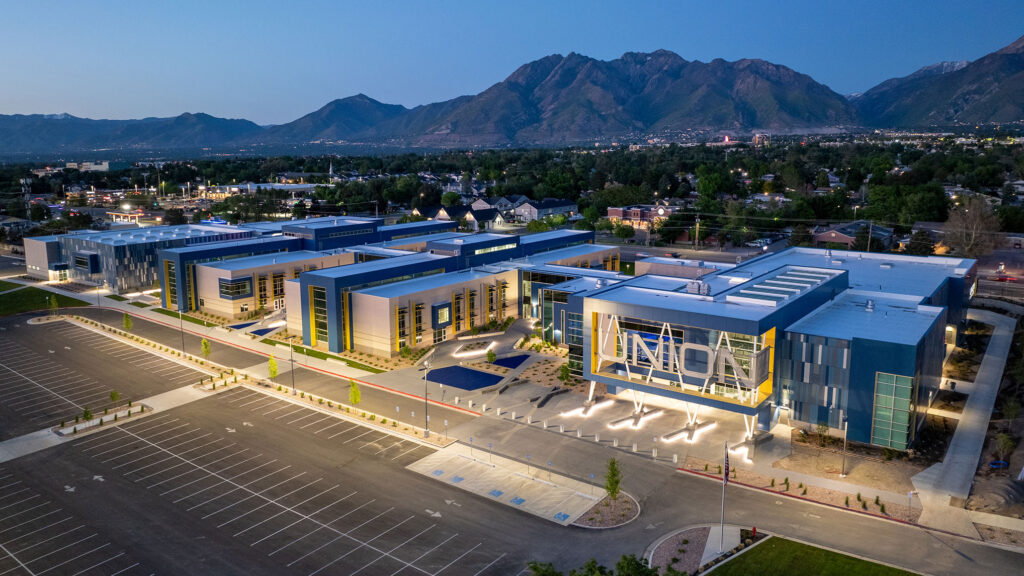
Union Middle School, Sandy, Utah.
Tilt-up was selected as a primary structural and finish system in response to labor availability and cost volatility, with panels intentionally expressed throughout key interior spaces—demonstrating the system’s suitability for durable, long-term educational environments. Photo: Jared Kenitzer
Educational facilities are inherently long-view projects. Durability, fire performance, acoustics, lifecycle cost, and adaptability often matter more than first impression alone.
Tilt-up aligns naturally with these priorities. Its robustness supports heavy use. Its repeatability allows campuses to grow incrementally without sacrificing coherence. Its performance characteristics serve both safety and operational goals.
Despite this alignment, institutional procurement habits often default to masonry or steel. Where tilt-up is introduced early and understood as a system rather than an alternative, it has proven especially effective for schools, campus buildings, and long-term educational infrastructure.
Civic, Cultural, and Assembly Spaces

Archangel Raphael Coptic Orthodox Church, Houston, Texas.
Tilt-up panels were employed as a primary structural and architectural system to support a highly expressive sacred space, with large, layered panels enabling a seamless aesthetic and accommodating complex roof and dome geometries. The project illustrates how tilt-up, when clearly understood and intentionally applied, can support civic and cultural architecture beyond conventional assumptions.
There remains a widespread belief that expressive or symbolic architecture requires lighter or more complex structural systems. Tilt-up is frequently excluded from civic and cultural work on this basis alone.
Yet tilt-up excels at what might be described as quiet monumentality. Large, continuous panels support strong spatial gestures. Curvature, sculpted edges, and surface manipulation are well established. The system’s economy often allows resources to be redirected toward interior experience, light, and program rather than enclosure complexity.
These projects demand clarity and confidence. Tilt-up rewards intentional design and exposes ambiguity—but when used decisively, it produces architecture grounded in permanence and presence.
Advanced Manufacturing and Specialized Industrial Facilities
As manufacturing has evolved, the image of industrial architecture has lagged behind. Many facilities now support specialized processes, sensitive equipment, and long-term adaptability, yet they are still approached with generic assumptions.
Tilt-up’s structural capacity, fire resistance, vibration tolerance, and enclosure performance make it particularly well suited to advanced manufacturing environments. Its ability to integrate complex interior systems within a durable shell is frequently underestimated.
Success here depends on early coordination and a clear understanding of process as much as structure. When those conditions are met, tilt-up aligns closely with contemporary industrial requirements.
Vertical, Mid-Rise, and Hybrid Applications
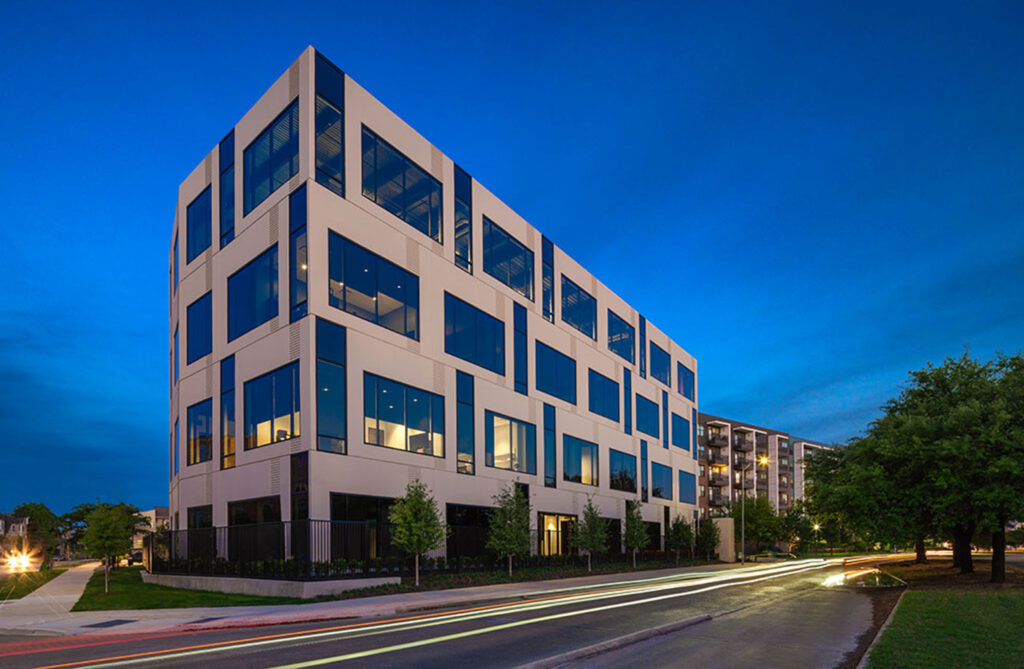
190 T.C. Jester, Houston, Texas.
Tilt-up was used as the primary structural system for a four-story Class A office building, supporting flexible floor plates, integrated amenity space, and urban site constraints. The project demonstrates how tilt-up can perform effectively in mid-rise commercial office environments when evaluated for system capability rather than building type.
Vertical tilt-up construction is often misunderstood—not because it lacks precedent, but because its role within the building is frequently mischaracterized.
Tilt-up has been successfully used in several vertical strategies:
- Tall load-bearing panels supporting four- to six-story office, medical, and institutional buildings
- Stacked panel systems, where smaller load-bearing or partially load-bearing panels are vertically repeated
- High-rise cladding applications, particularly in Florida and coastal markets, where tilt-up panels serve as non-load-bearing enclosure on nine-, ten-, and eleven-story hotels and dormitories
These applications are not marginal. The tallest tilt-up panel on record exceeds 111 feet, and tilt-up panels have been successfully used as cladding on buildings up to eleven stories.
The determining factor is not height alone, but clarity of intent. Tilt-up performs vertically when its role—primary structure, stacked system, or high-performance enclosure—is clearly defined and properly coordinated with other building systems. Problems arise not from vertical ambition, but from blurred expectations.
Repeatable Commercial and Service Buildings
Portfolio-driven owners—retail, service, healthcare support, and mission-critical facilities—often value consistency as much as flexibility.
Tilt-up offers a rare balance of repeatability and variation. Buildings can share a common system without becoming indistinguishable. Local sourcing, speed of construction, and long-term performance make tilt-up well suited to organizations managing multiple sites over time.
When applied thoughtfully, the system supports both operational efficiency and architectural differentiation.
What These Building Types Share
Across these building categories, a consistent pattern emerges. Tilt-up performs best where:
- durability and lifecycle performance matter
- schedule certainty is critical
- cost discipline is real
- architecture values clarity over excess
- owners think beyond first use
These are not niche priorities. They are increasingly central to responsible building.
What This Does Not Mean
Recognizing tilt-up’s broader applicability does not suggest it should be used everywhere. It is not universal. Some sites, programs, and urban conditions are better served by other systems.
Credibility depends on acknowledging limits as clearly as strengths. Tilt-up succeeds when it is chosen intentionally—based on understanding, not habit.
Learning to See Systems Clearly
The future of tilt-up construction will not be defined by expanding claims, but by expanding understanding. When project teams learn to evaluate delivery systems on their own terms—rather than inherited assumptions—better buildings follow.
The most productive shift is not asking whether tilt-up can do more, but recognizing where it is already being misread—and correcting that evaluation with clarity.
Tilt-Up Concrete Association

Be the first to comment