
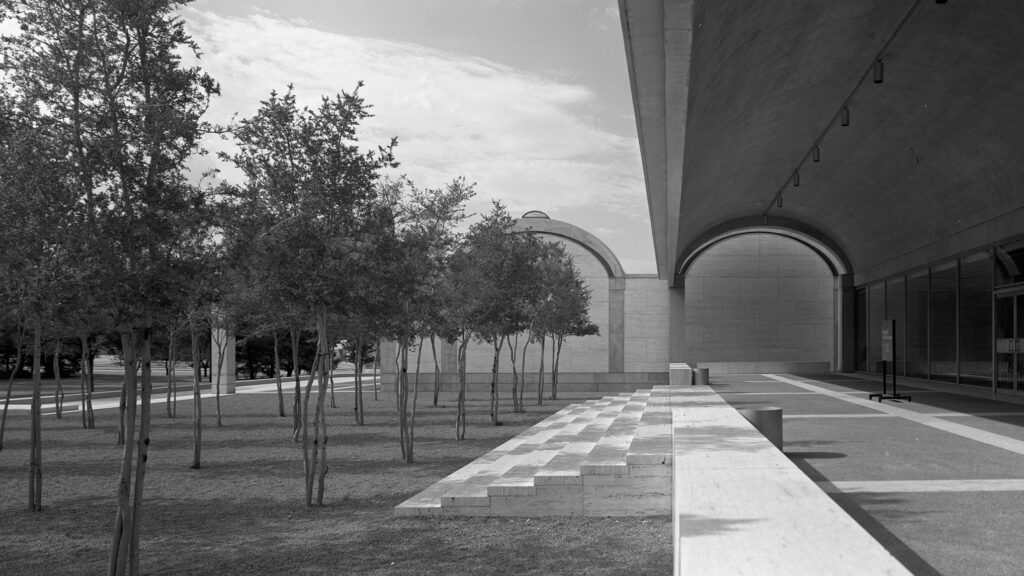
Threshold condition at the Kimbell Art Museum, where movement from shelter to light is both defined and inevitable. Photograph by Balthazar Korab, courtesy of the Library of Congress.
Leadership has always required absence.
Years ago, a close friend and past president of the Tilt-Up Concrete Association offered an image that has stayed with me. He described a company as a kind of pack. There is a place of shelter—safe, familiar—where younger members can remain, learning and growing, protected by the work of others. But those responsible for sustaining the group must leave that shelter. They take on risk, bring work back, and accept a different kind of responsibility. Once they step into that role, they do not return to the cave in the same way again.
There is danger in that departure. There is also freedom.
I’ve been thinking about that metaphor more frequently as of late, prompted by conversations with our board of directors. Several members described encouraging their emerging leaders to attend the Tilt-Up Convention and Expo—to step outside their daily routines and into the broader industry. Many declined. The reasons were understandable: young children, busy spouses, demanding schedules, a careful effort to protect work-life balance.
And yet, as the conversation continued, something else became clear. Those conditions are not unique to any stage of life. They do not disappear with seniority or success.
In the same year, our outgoing board president welcomed grandchildren, faced a serious health scare, left a longtime role to start a new company, and lost close friends. It was, by any measure, a year of disruption and gravity. And still, he showed up. Not because the timing was convenient—leadership rarely is.
Every generation, of course, believes the next one is different. And every generation is right.
What feels distinct in this moment is not the presence of competing obligations, but how they are weighed. Leadership once demanded physical presence almost by default—travel, long days away, relationships built through repetition and shared inconvenience. Today, connection is faster, lighter, and more mediated. Exposure is optional. Distance is normalized. The cave, in many ways, has become more comfortable.
The question, then, is not whether leadership has changed—it clearly has—but whether the essential act of leaving the cave still matters. Has business shifted so decisively that leadership no longer requires separation from comfort? Have relationships become so abstracted that presence is no longer formative?
I remain unconvinced.
Tools evolve. Contexts change. Expectations shift. But leadership still requires exposure. It still asks individuals to accept uncertainty on behalf of others. It still involves stepping into rooms where outcomes are not guaranteed and value is not immediately measurable. Relationships may form differently today, but they remain foundational. Trust, mentorship, accountability, and shared experience cannot be fully outsourced or automated.
What may be changing is not the requirement to leave the cave but what leaving looks like—and how consciously one chooses to do it.
As an Association, our responsibility is not to preserve past models for their own sake, nor to resist generational change. It is to recognize leaders—wherever they are—and to help them understand the moment when staying comfortable begins to limit both their growth and the growth of those who depend on them.
Leadership has never been safe. It has never been convenient. And it has never been accidental.
At some point, someone has to decide to leave the cave.
Sincerely,
By Mitch Bloomquist
Executive Director
Tilt-Up Concrete Association


Be the first to comment